About the Founder
The Story Behind Dive Into a Coach Approach®
Built in healthcare. Grounded in adult learning. Held to professional coaching standards.

I am Hélène Thériault, an Occupational Therapist, Master of Adult Education, and ICF Master Certified Coach. Dive Into a Coach Approach® is what happened when those three parts of my professional life finally came together.
The methodology did not begin with a business plan or a stackable certificate pathway. It began with a question I could not stop asking in clinical practice:
How do we help people move from knowing what to do to taking meaningful action, without the healthcare professional carrying the entire outcome?
For four years, I tested that question in my own practice. Then, in January 2020, I gave myself the space to turn what I had learned into something other healthcare professionals could use, teach, question, and trust.
Read the clinical origin story in Goal Achieved ›
The Story Did Not Begin in a Boardroom
If you have read the Goal Achieved story, you know about the client who changed the direction of my career. After six months without meaningful progress, I tried a Coach Approach with him. We began seeing movement where there had been none. That experience gave me a reason to keep going.
What happened over the next four years is the part I have not told as often.
I kept using a Coach Approach in my practice. I watched what happened for my clients, and I noticed what changed in me as a clinician. Success stories accumulated. Outcomes improved across my caseload. I was receiving more referral requests. My employer noticed. The fee payers connected to my work noticed too.
The question was no longer simply, Does this work in healthcare?
The question had become: Can I teach someone else to use it without losing what makes it work?
Then I was invited to deliver an eight-hour workshop for healthcare professionals who wanted to use a Coach Approach in their own practice.
I knew a collection of questions, tips, or borrowed coaching tools would not be enough. Healthcare professionals needed a concrete model and framework. It needed to be grounded in evidence-based practice, connected to professional coaching competencies, and designed around the realities of healthcare.
I was almost ready to teach it.
First, I needed to build it.
What Came Together at Vancouver Harbour
A suitcase of books, a harbour view, and the space to think
In January 2020, I booked a staycation at the Pan Pacific in Vancouver. The harbour sat right outside my window. I arrived with an entire suitcase of academic and coaching books.
By the second day, the floor of my room was covered with them. Books lay open to a dozen different models and frameworks. I moved between them, making notes about what might work in healthcare, what would not, and which ideas connected back to the theory I had studied during my Master of Adult Education.
I was not looking for a framework that only sounded good in a workshop. It had to hold up in short clinical conversations, complex cases, interdisciplinary care, formal documentation, and professional scopes of practice. It had to respect what healthcare professionals already know while helping them recognize when expertise alone is not the next thing a person needs.
I was not trying to make healthcare professionals sound like coaches. I was designing a way for them to lead different conversations inside the realities of healthcare.
That hotel room became the design studio for what would become Dive Into a Coach Approach®.

The Iceberg Gave Me a Way to Explain What I Had Learned
All of that reading was in service of something I had begun noticing years earlier.
Healthcare professionals already do so much well. We observe behaviour, strengths, function, and results. We are skilled at working with what can be seen at the top of the iceberg.
Just below the surface are the person’s situation, experience, and emotions. I could reach that layer too.
But when progress remained stuck, there was often a deeper layer we had not reached: the person’s perceptions. Their beliefs, attitudes, judgments, and assumptions about themselves, their situation, and what change might require.
When the real obstacle lives beneath the surface, staying at the top of the iceberg is rarely enough.
That insight gave me the model. It also gave me the name.
Dive Into mattered to me. It meant trusting the conversation enough to go beyond what is immediately visible. It meant helping someone explore what may be shaping their choices beneath the surface, without assuming we already know the answer.
That is where the iceberg came from, and where Dive Into a Coach Approach® began to have an identity of its own.
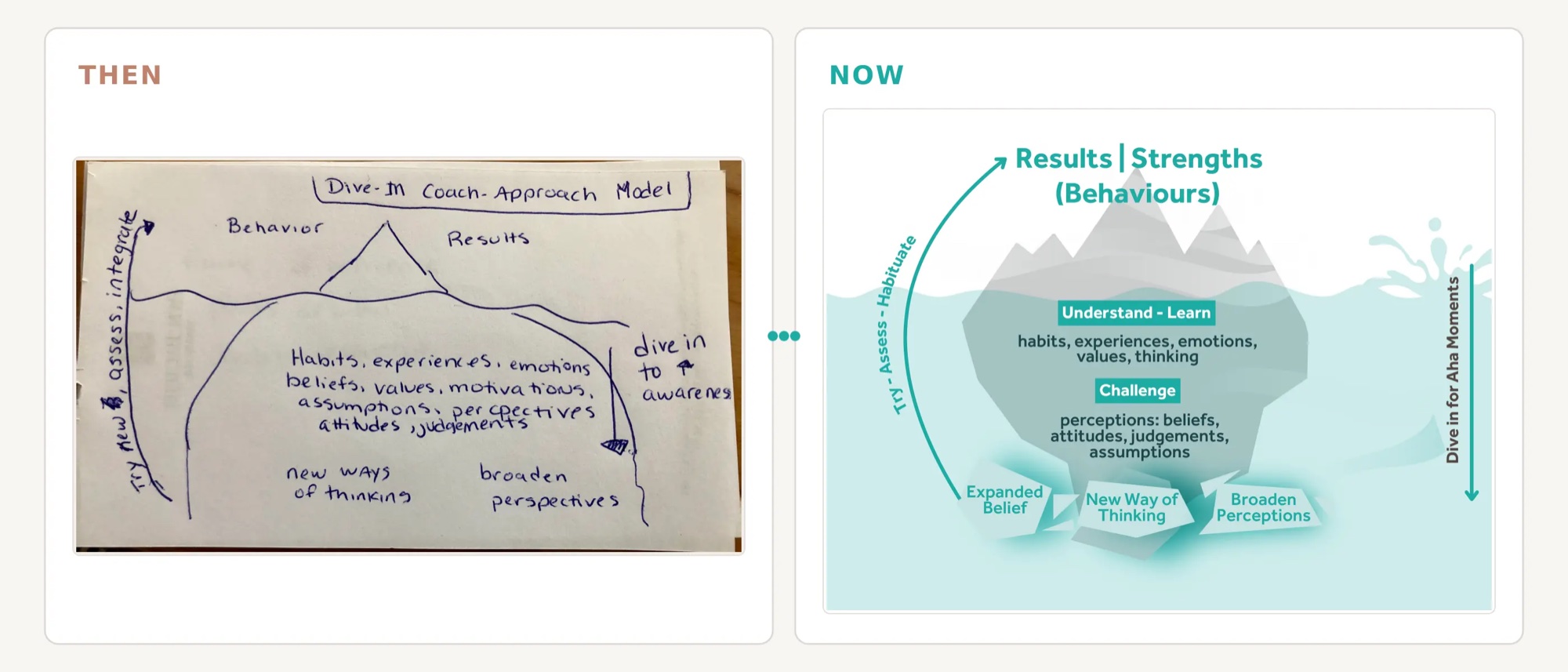
Above the surface sit behaviour, strengths, and results, the part of a person’s situation we can see and measure. Just below sit their situation, experience, and emotions. Deeper still sit their perceptions: the beliefs, attitudes, judgments, and assumptions that shape what they believe is possible.
Then the Conversation Needed a Map
A model could explain why going beneath the surface mattered. Healthcare professionals still needed to know how to lead the conversation.
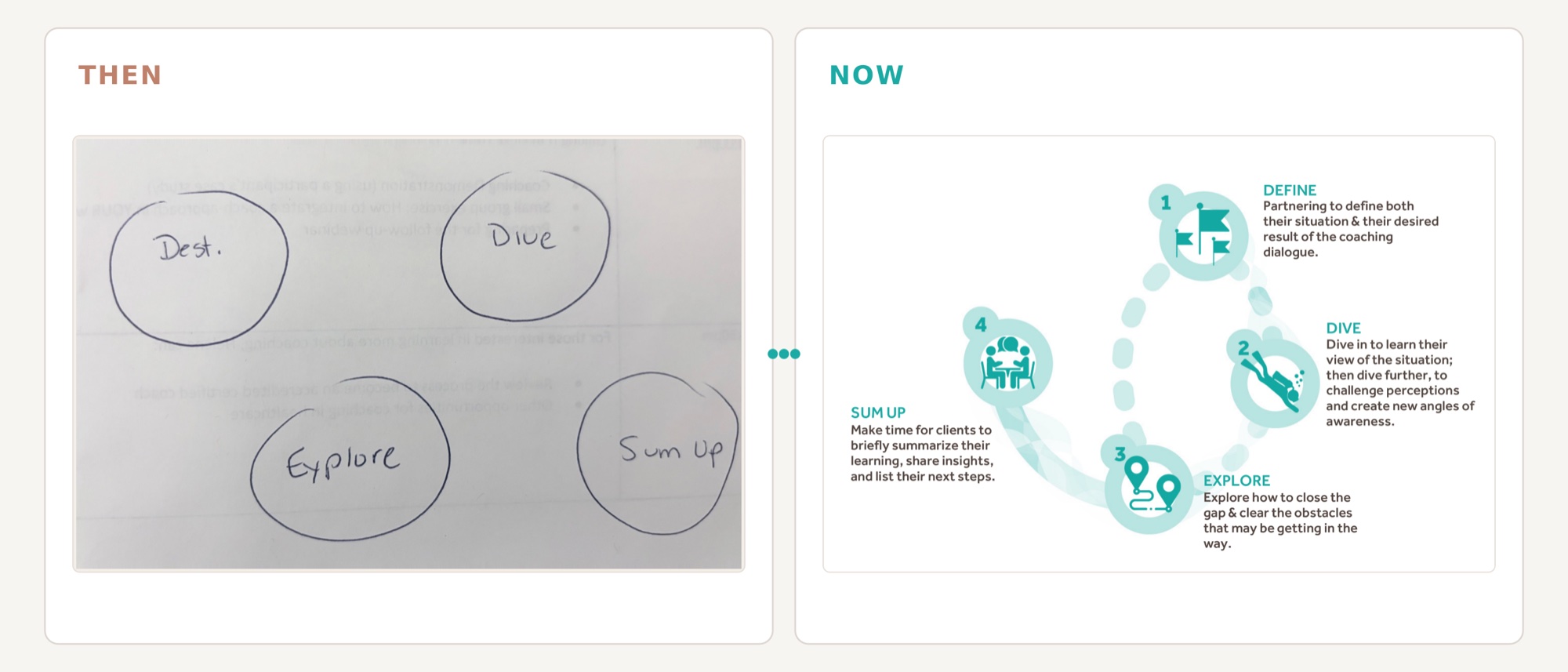
Somewhere in that sea of books, I sketched four steps by hand:
Destination. Dive. Explore. Sum up.
Destination later became Define, but the shape of the framework was there from that first sketch. Define where the conversation is going. Dive beneath the first answer. Explore what becomes possible. Sum up so insight has somewhere meaningful to go.
Once I had the four steps, I asked a second question: What skills does someone actually need to complete each one?
For each of the first three steps, I developed three techniques. For Sum up, I identified three reasons that final step matters and one technique to help prevent a meaningful conversation from ending without a clear next move.
The framework gave the conversation a shape. The ten techniques made each step teachable.
Those same ten techniques still form the DICA 1 foundation today. As the pathway later deepened, DICA 2 added three more advanced techniques.
The Doing Was Not Enough
The model, framework, and techniques gave me the doing: how to structure and lead a coaching conversation.
But something was still missing.
There was a way of being underneath the skills. It was the part that had gradually changed how I showed up with clients altogether: less pressure to fix, more curiosity, more trust in the other person’s capacity, and greater awareness of what the conversation needed from me.
I returned to professional coaching competencies from the ICF, NBHWC, and others. They were accurate and important, but they were also detailed, wordy, and difficult to hold onto in the middle of a real healthcare conversation.
So I built four metaphors instead. Something memorable enough to return to when time was short or the expert in you wanted to take over:
The Amateur
Setting aside the assumption that we are the expert in the room, and trusting that the person in front of us is the expert in their own life, situation, and thinking.
The Environmentalist
Protecting the coaching space from our own solutions. We resist the urge to hand someone a route to follow, and we do not judge the path they choose.
The Discoverer
Curiosity, openness, and flexibility about what we will uncover together. We ask, we listen, we look from several angles, and we stay open to what emerges.
The Olympian
Treating the other person’s journey as a privilege. We offer encouragement when it is needed and celebrate progress, however small, without running the race for them.
These became the four DICA mindsets. They gave healthcare professionals a practical way to remember not only what to do, but how to enter the conversation.
A framework can guide what you do. A mindset changes how you show up while doing it.
Three Parts of My Professional Life Came Together
Looking back, I can see that every design decision drew from three parts of my professional life.
The Clinician
As an Occupational Therapist with more than 24 years in healthcare, I understood the realities the methodology had to respect: complex health conditions, limited time, professional scope, clinical judgment, documentation requirements, interdisciplinary teams, and the responsibility clinicians often carry for whether change happens.
The Adult Educator
My Master of Adult Education shaped how the methodology needed to be taught. Adults do not change practice because they receive more information. They need relevance, reflection, meaningful application, practice, and feedback. My work as a Clinical Instructor at the University of British Columbia and as a certified instructional designer kept the learning participant-centred and usable.
The Coach
My professional coach education gave the methodology its competency foundation. Becoming an ICF Master Certified Coach deepened the standard I held for listening, presence, partnership, and ethical practice. The 2023 ICF Coaching Impact Award for Emerging Coach Educator later recognized the educational work that grew from that foundation.
Clinical experience made it relevant. Adult education made it learnable. Professional coaching standards made it rigorous.
Together, those three perspectives became three commitments that still guide DICA:
- The learning must work inside healthcare, not only in a coaching classroom.
- The methodology must remain grounded in evidence, theory, and ongoing review.
- The skills must remain aligned with recognized professional coaching competencies.
The First 48
About four months after that Vancouver staycation, I delivered the first eight-hour workshop to 48 healthcare professionals.
It was the first time the model, framework, techniques, and mindsets existed together outside my own practice. The participants brought their disciplines, populations, time constraints, and questions into the room. They helped show me what translated clearly, what needed more explanation, and where healthcare professionals needed more than a single workshop.
What began as an eight-hour workshop was becoming a learning journey.
That first workshop evolved into what we now call Goal Achieved. As graduates began applying the methodology, the next learning needs became visible.
They needed protected practice and feedback. That became Second Nature.
They needed supported implementation with a real client. That became Into Practice.
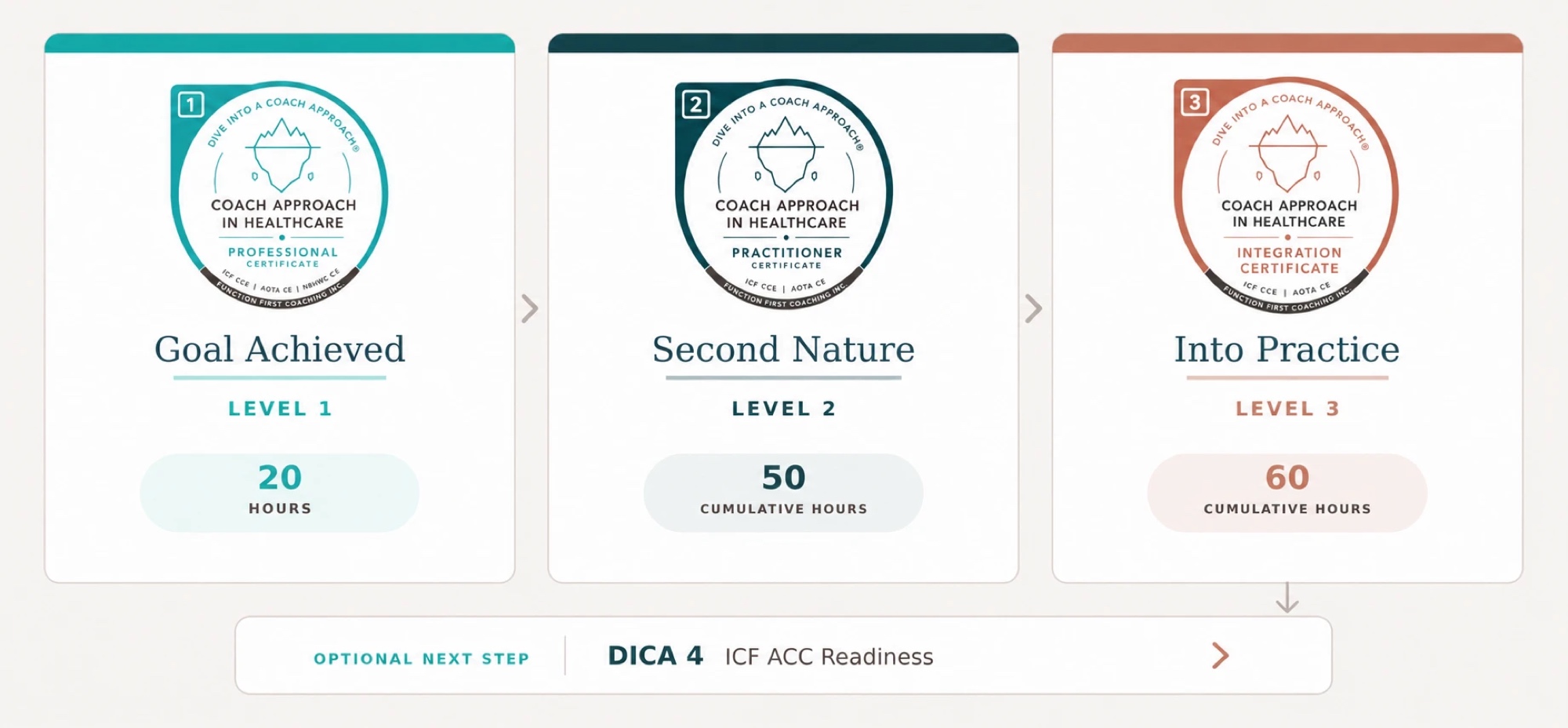
Today, those three levels form a 60-hour stackable certificate pathway created specifically for healthcare and helping professionals. Each level introduces the next just-right challenge:
- Goal Achieved: build the foundation and earn the Level 1 Coach Approach in Healthcare Professional Certificate.
- Second Nature: move from knowing to doing through practice, feedback, and Relationship Intelligence, earning the Level 2 Coach Approach in Healthcare Practitioner Certificate.
- Into Practice: apply and adapt the methodology in a supported real-client relationship, earning the Level 3 Coach Approach in Healthcare Integration Certificate.
DICA 4 supports graduates preparing to pursue the International Coaching Federation (ICF) Associate Certified Coach (ACC) credential. This optional next chapter includes mentorship and performance evaluation.
Earning the Stamp of Professional Trust
Seeking professional recognition for a healthcare coaching program
Once the program was developed, one of my first priorities was professional recognition.
Healthcare professionals needed to know that although they were learning these skills in a clinical, rehabilitation, leadership, or community-health context, the education remained connected to recognized coaching competencies.
I also wanted external review. If I was asking healthcare professionals to trust a methodology I had created, I needed to be willing to show how the learning objectives, activities, theory, and competencies fit together.
First: International Coaching Federation
I submitted DICA for International Coaching Federation Continuing Coach Education approval. When it was approved, it provided an important first layer of professional trust: a healthcare-specific program could still teach genuine coaching competencies and meet formal continuing-education requirements within the coaching profession.
Then: American Occupational Therapy Association
Next came the American Occupational Therapy Association. I wanted occupational therapists to be able to access continuing education recognized within their own profession, without suggesting that requirements are identical across every jurisdiction.
That process required detailed learning objectives, course descriptions, educational methods, and competency mapping. It was a considerable amount of administrative work, but it made the program stronger.
It also gave me a reusable evidence package. When another health association, employer, or licensing body asks how a physiotherapist, chiropractor, speech-language pathologist, nurse, or other healthcare professional is developing real coaching competencies, I can show them.
Then: National Board for Health & Wellness Coaching
The next step was NBHWC continuing education approval. That extended the circle of professional recognition into health and wellness coaching and confirmed the relevance of DICA learning for professionals working across health, behaviour change, and wellbeing.
I wanted DICA to be understandable to both worlds: healthcare and professional coaching. Accreditation required me to show the bridge.
Today, DICA course offerings provide continuing education recognized through ICF, AOTA, and NBHWC. The exact credits vary by course and level, but the commitment underneath them remains the same: the learning must be transparent, accountable, and worthy of professional trust. Each program page lists the current credit totals for that level.
The Person Behind the Methodology
I grew up bilingual in Grand Falls/Grand-Sault, New Brunswick, where community, family, and showing up for one another were part of everyday life.
Competing internationally in synchronized figure skating taught me something I still carry into this work. You can be individually skilled and deeply committed, but the result does not belong to one person alone. It depends on awareness, timing, trust, and the ability to move in relationship with other people.
Perhaps that is why the shift from fixer to partner has always felt so important to me.
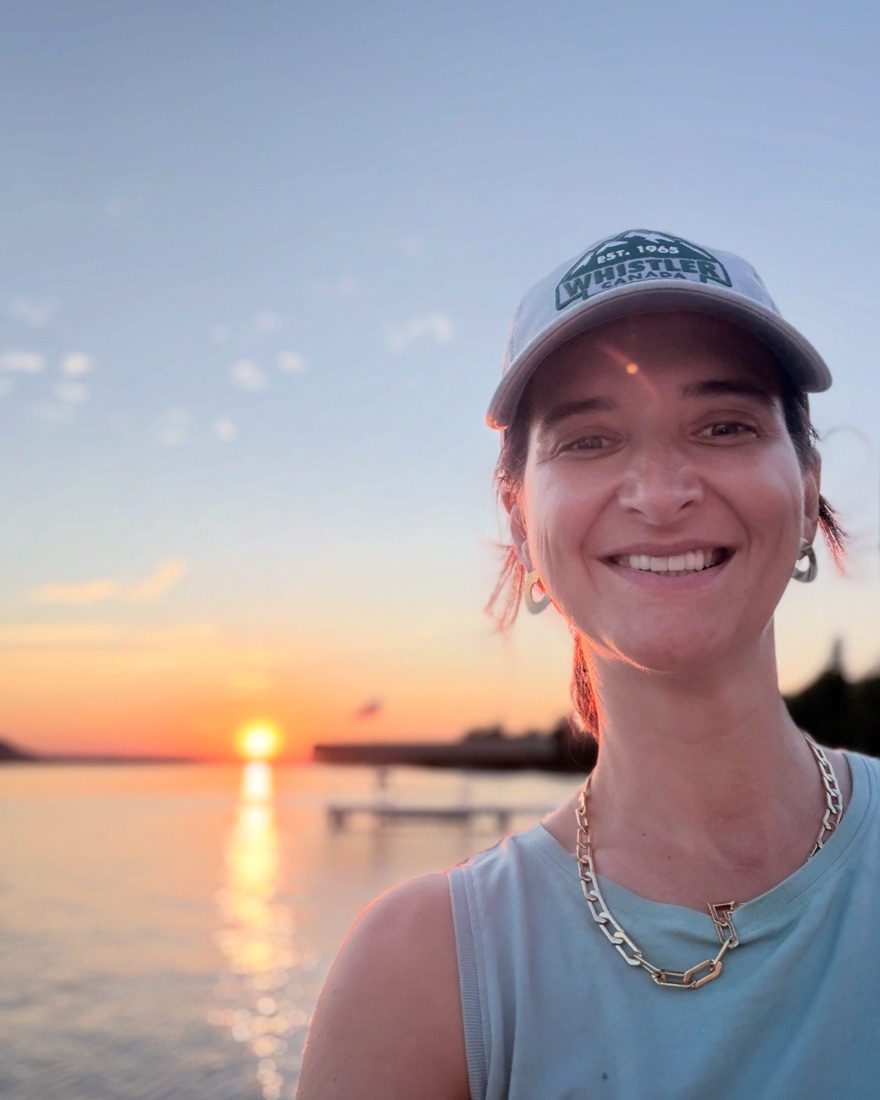
Today, British Columbia is home. Outside this work, you will often find me skiing with my husband and two children, playing beach volleyball, or moving between French and English in the life we have built here.
The methodology is rigorous because healthcare deserves rigor. It is practical because clinicians need something they can use. And it is human because the conversations at the centre of healthcare are human.
Professional Foundation
- Registered Occupational Therapist since 2002; more than 24 years in healthcare.
- Master of Adult Education, St. Francis Xavier University.
- ICF Master Certified Coach.
- Clinical Instructor, University of British Columbia.
- 2023 ICF Coaching Impact Award: Emerging Coach Educator.
- Certified Instructional Designer and Certified Virtual Trainer.
DICA provides professional development education. It does not replace clinical judgment and does not automatically confer an ICF coaching credential.
Why This Work Matters Even More Now
When I first created Dive Into a Coach Approach®, I was focused on a problem I could see in front of me: healthcare professionals working harder while patients and clients remained stuck, and both people feeling the weight of that experience.
That problem has not disappeared. But the context around it is changing.
AI can generate information, recommendations, summaries, and plans faster than any of us could have imagined when I sketched that first framework. Clinical knowledge and evidence will always matter. Technology can support both.
What it does not replace is the human work of helping someone examine what matters, recognize what is getting in the way, make meaning of their options, and choose an action they are prepared to own.
The easier information becomes to access, the more valuable the human conversation becomes.
That is why the mission of Function First Coaching™ is to shift healthcare from the inside out by changing how healthcare professionals lead conversations that build ownership, participation, and meaningful action.
Our goal is to reach 100,000 healthcare professionals by 2030.
Not so everyone practises in exactly the same way. So more professionals know when to educate, when to recommend, when to coach, and when a different kind of conversation may help another person move forward.
The Story Is Still Being Written
What began with one client, four years of noticing, a suitcase of books, and 48 healthcare professionals has become a methodology used across disciplines, populations, and practice settings.
More than 1,000 healthcare professionals have now completed Goal Achieved. Each one takes the learning somewhere I cannot fully predict: into a treatment session, a rehabilitation plan, a leadership conversation, a classroom, a team meeting, or a conversation at home.
That is how a methodology grows without losing its centre.
The purpose was never to make healthcare professionals less expert. It was to help them use their expertise more intentionally and know when partnership may take the conversation further.
If that is the kind of practice you want to build, there is a place to begin.
Begin with the 90-minute Dip Your Toe module, then decide from experience whether the complete DICA journey fits your practice.
Start Your Dive