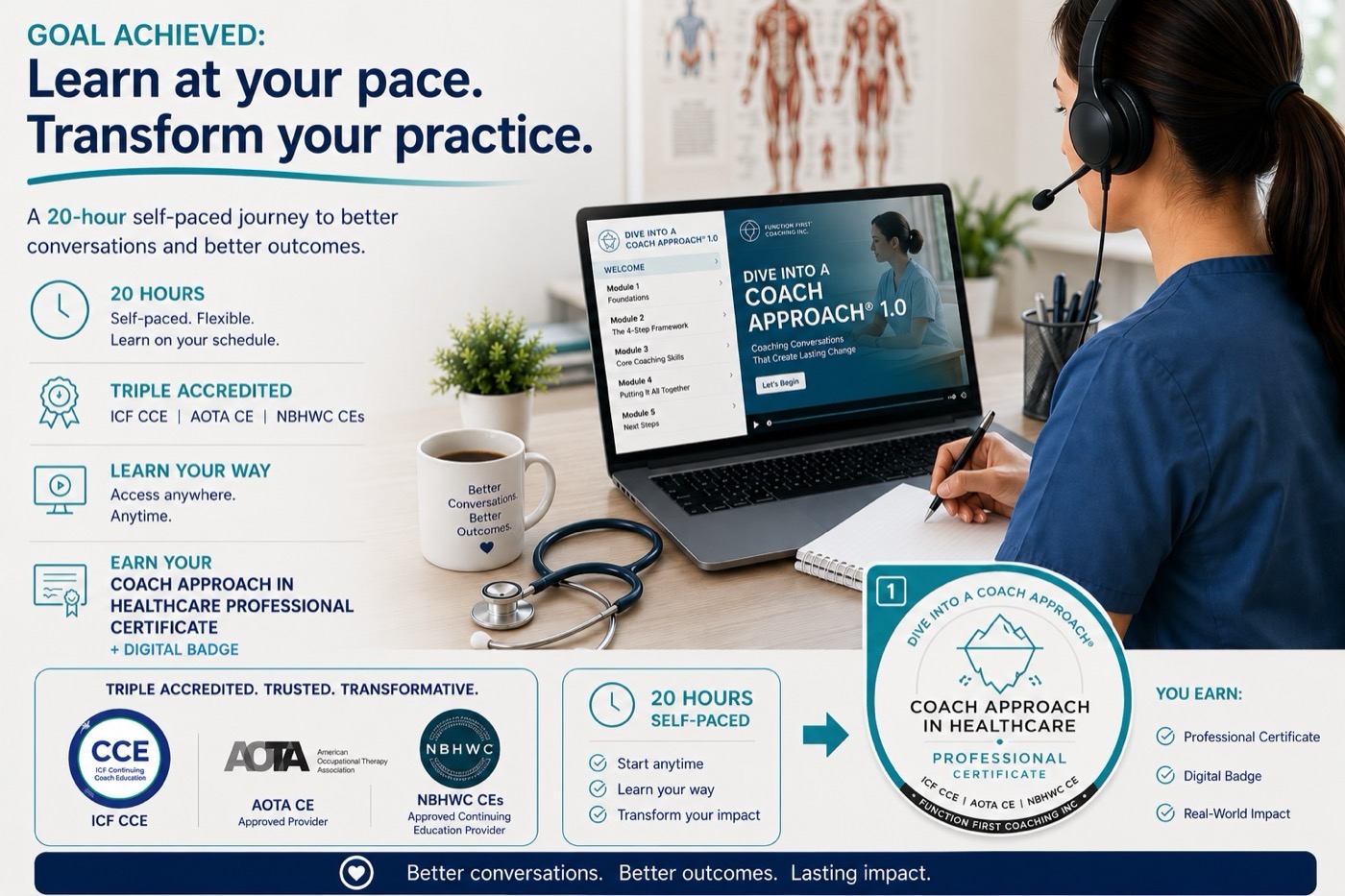
Dive Into a Coach Approach® · Level 1
Goal Achieved
Helping Healthcare Professionals Build the Human Skills That Matter Most in an AI‑Assisted World
How to go from writing “Goal Not Achieved” on a Friday afternoon to consistently writing “Goal Achieved”, in as little as six months for your most complex cases, and as little as three sessions (or six weeks) for less complex cases.
In a time when AI can generate information in seconds, the conversations that help people change still depend on something deeply human. That’s the journey this story is about.
The best way to understand how you can get there is to look at how I got there.
Let me tell you the story of how I transformed my own practice, rediscovered why I loved healthcare, and found a way to achieve better outcomes without sacrificing myself in the process.
This is the story of how a Coach Approach helped me stay in the profession I loved while helping my patients achieve more meaningful and lasting change. It isn’t a magic pill. It’s the true story of my own transformation, grounded in evidence, and the story that hundreds of healthcare professionals have since begun writing in their own practice.
It all started when…
Driving Home with Four Failed Reports
The Thursday Drive That Questioned a Fourteen-Year Career

I remember exactly what I was wearing. I remember the car I was driving. I remember the scenery in front of me, because I have replayed that drive so many times since that it is stitched into me now.
I had just seen four community clients. I was driving home. And for the first time in fourteen years of doing this work, I thought: I do not want to go to work tomorrow. Maybe I’m done with healthcare. Why am I doing this?
Have you ever thought that?
It was not dramatic. No crying, no pulling over. It was quieter than that, and worse, because it was head to toe. It sat in my chest, my shoulders, the backs of my knees. Fourteen years, and I had never once had that thought before. I kept driving, but that thought stuck.
Why Did Writing “Goal Not Achieved” Feel Like a Personal Failure?
Here is what was waiting for me the next day, and why I was dreading going to work. It was the Friday I had blocked for report writing. I had seen four clients that Thursday. None of them had followed through on what we had agreed to. I had four reports to write, and every one of them would say the same thing: goal not achieved, or goal partially achieved. Again.
So I did what I often did with that. I turned it inward and pointed the finger at myself. I thought: Did I write the wrong goal? Did I not give the right intervention? What did I miss? Maybe I hadn’t explained it well enough. Maybe I hadn’t helped them see why the plan mattered. Essentially, I figured it was my fault.
And too many of us do this to ourselves, don’t we?
Not surprisingly, I worked harder. A lot harder. More prep. More pressure on my own shoulders. I was tapped out and feeling defeated and, yes, I even doubted whether I had picked the right profession. I was on the path to burnout, but I did not call it burnout yet.
Why I Was Shocked at the Thought of Leaving Healthcare
How a Grade-Nine Promise Led to My Healthcare Path

I need to back up, because none of this makes sense unless you know how much I had already chosen this, on purpose, more than once.
I knew by about grade nine that I was going to work in healthcare. How old were you when you knew? I did not know what, exactly, only that helping people was the thing, and it had been the thing since I was about eight years old. There’s a story behind that too, but I don’t want to make this too long. Ask me and I’ll tell you.
I had thought about becoming a doctor and let that go, because it did not feel immersive enough, not the kind of closeness to people’s lives I was looking for. Two years into a seven-year university path, I worked a summer as a physiotherapy assistant. I got close, genuinely close, to choosing physiotherapy as a career. I remember thinking: There is a lot I like here, but there is something missing.
That same summer, someone mentioned occupational therapy to me. I did not know what it was. I looked into it and, not long after, I shadowed an OT named Julie for a single afternoon in my hometown. It took less than an hour of watching her work for me to know for certain that this is what I would do for the rest of my life.
Here is what I watched. A man came in who had not been able to walk for months after a severe injury. He brought his toddler with him to the appointment. Julie adapted his insoles, and by the end of that session, he was throwing a ball with his child again. My eyes welled up watching it. His did too. That was it. I knew.
What was your moment?
Okay, so back to my story, where I was questioning that healthcare career choice.
I Found the Missing Piece, and Surprisingly, It Was Outside of Healthcare
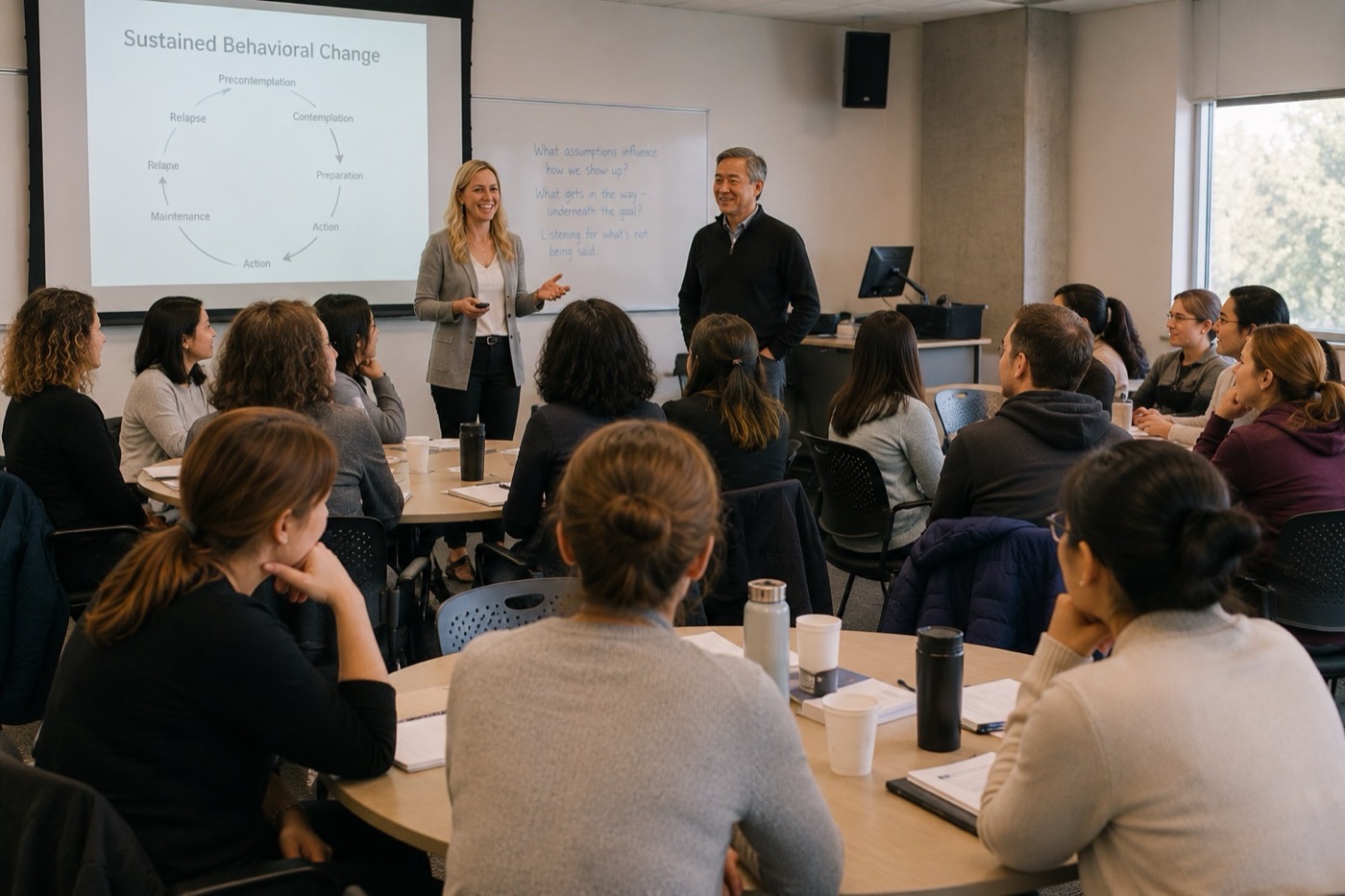
Several months after that first time I questioned my career choice, I found myself in a clinical leadership role and signed up for a coaching course. It was not built for healthcare. It was built for people leading teams in offices, not people treating patients. I sat in that room anyway, just hoping it would help with my clients and not only with leadership.
Somewhere in that course, hearing them talk about sustained behavioural change, stages of change, and the barriers that live underneath a person’s stated goals, something in me sat up. Is this what I have been missing for fourteen years? My mouth was hanging open, and I thought:
“Whoa, wait a minute… would this Coach Approach thing not work for my clients too?”
Part of why I trusted what I was learning was that I recognized the theory behind the methodology. It closely matched what I had just finished studying for five years in a Master of Adult Education. I focused on transformative learning theory, and this course was talking to that same material through a slightly different lens. That was more than enough to keep me listening.
And not just listening. I had questions. A lot of questions that this course was not built to answer.
I asked this, live in the course:
“How do you use this with a client who has PTSD, without triggering symptoms? Or a brain injury, where the client may not generate their own solutions the way this framework assumes people can?”
But I also thought these:
How do I document this approach in my clinical notes and recommend it as an intervention? How do I explain this approach to the rest of my team and to insurance payers?
To their credit, the instructors did their best, but they did not have healthcare answers. They had not built this for healthcare. I was going to answer those questions myself.
I would have to trust the methodology and find out for myself. There is not a lot of damage you can do, I told myself, by being more curious and less directive. I didn’t know yet if it would work, but I was certain it would do no harm, and I was ready to try it.
The Client Who Gave Me the Place to Find Out
One of the Most Complex Cases I’ve Had the Privilege of Working Through With a Coach Approach

When I do something, I don’t just dip my toe in the water. I really dive in. Can you relate? So my first test of a Coach Approach had to be the toughest case for me to really believe there was a space for this approach in healthcare.
I had a client who was top of mind, and he gave me the place to find out. He had a brain injury, PTSD symptoms, and partway through my time with him, he was diagnosed with depression on top of everything else. He had two young kids, a wife, and thirty more years of work life ahead of him. He had not worked in over a year.
We had a large interdisciplinary team trying to support him to return to work, and we met monthly. Those first six months, there was no progress. Work harder, no change. Keep at it, no progress. Continue working harder, no change. Keep at it, no progress. Work even harder again, no change.
Have you ever wanted to smash the keyboard because you felt you had failed a client?
I did. And I thought: This is the client I owe it to, to try something different.
After six months of that, I decided to try the Coach Approach with him. I did not walk in and wing it. I wrote out a script beforehand and practised it. I made sure I had his buy-in before I started. He looked at me and said something like: “What do we have to lose, Hélène, at this point, right?”
What I found once we started was not what I expected. I was good, it turned out, at the surface of things: habits, experience, how someone was feeling that day. I could work at that layer all day long. So many of us are really good at this layer, but it is not enough. There was a second layer I did not know about.
What I had never done, what I did not dive into, not with him, not with anyone, was go underneath it, to the layer where the real blockers live: what someone believes, what they assume, and what judgment they are quietly carrying about their own situation.
What I discovered with him, and with many others later, was this:
Looking back, I realize this is exactly why these conversations matter even more today. Information is becoming easier to access than ever before. What remains uniquely human is helping someone uncover the beliefs, assumptions, emotions, and motivations that determine whether change actually happens.
It was not stubbornness.
It was not noncompliance.
It was that he was pessimistic and angry about his injury, and nobody, including me, had gone near that perceptual barrier directly. That was the boulder.
Not his exercises.
Not his home program.
Not his brain injury symptoms.
This was the moment for me. It’s difficult to describe what happened next, but I’ll try. Here is what I did to implement a Coach Approach as an intervention for the very first time.
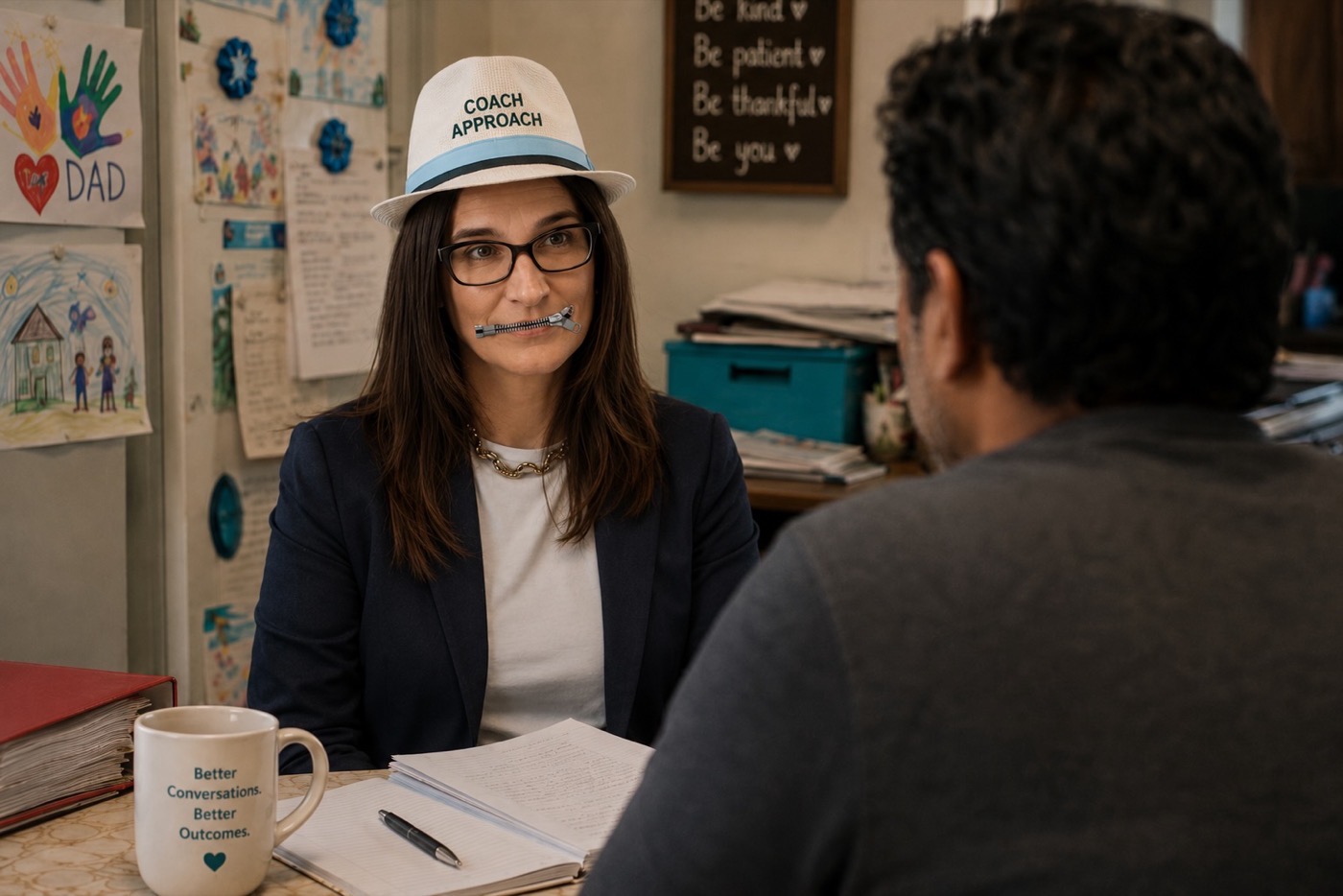
Over about ten sessions, approximately an hour each, we split the time evenly: thirty minutes of traditional therapy and thirty minutes of coaching. I needed a way to signal to both of us when I was changing modes, so I started imagining that I was putting on a coaching hat, with a phrase to go with it: zip it up. That was me telling myself, and telling him without saying it aloud, that the fixing part of me was done talking for a while.
Then We Started Seeing Something
You won’t believe this, and I could hardly believe it either, but after six months of nothing, we started seeing something. Small. Real. His steps, in the right direction. Not a finish line, just movement where there had been none.
And it did not stay contained to him. It rippled out and reached into his home, into how things were going with his wife and his two kids. I was pleased to discover that it had a wonderful positive impact on more than my client. His family benefited too.
My team noticed too. Small steps, where there had been none for six months, got noticed in our monthly meetings. There was such a noticeable difference in results that they asked me directly, in the meeting, to define precisely what I was doing differently to get these results.
Looking back, I didn’t realize it then, but that one client changed the rest of my career. It changed how I practiced, how I taught, and ultimately why Function First Coaching exists today.
And I had to explain it on the spot.
I think we would all love to be asked, “What are you doing differently?” or “How are you getting these results?” and have those questions relate to “Goal Achieved,” not “Goal Not Achieved.”
It Was Time to Try It With More Than One Client
Repeating It Revealed More Surprises
Once I had one client for whom this worked, I went looking for the next ones. Not the easy ones, nope. I chose the three to five clients on my caseload who were taking the most of my time.
It helped them, and here is what surprised me:
It helped me too.
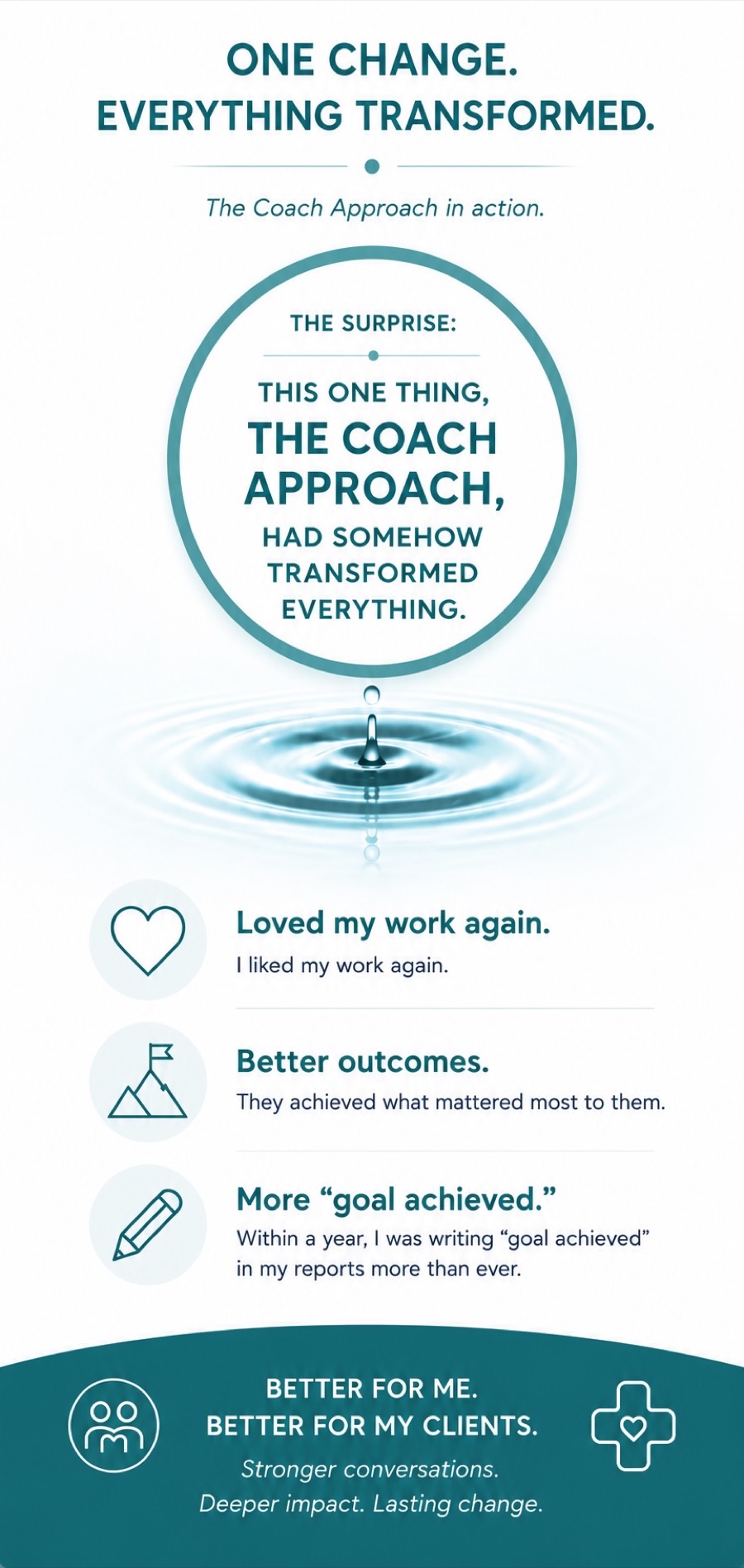
My rehab planning time went down. I could take on more clients. I liked my work again. Within a year, I was writing “Goal Achieved” in my reports more than I ever had before. My clients’ satisfaction went up. So did my confidence.
I started bringing a Coach Approach into every clinical lead and mentorship meeting I ran. My clients were more accountable too, and more likely to follow through on what we had agreed to.
This one thing, the Coach Approach, had somehow transformed everything.
Why This Matters More Than Ever
When I first began teaching this Coach Approach, I believed its greatest value was helping healthcare professionals improve client outcomes while reducing burnout. I still believe that.
But today I see something more.
We are entering a world where information is increasingly available in seconds. Clinical knowledge will always matter. Evidence will always matter. But the ability to help another human being discover their own motivation, navigate uncertainty, and create meaningful change is becoming even more valuable.
Curiosity. Trust. Partnership.
Those are the human skills that will define exceptional healthcare professionals in an AI-assisted world. Goal Achieved was designed to help you build them.

What Healthcare Professionals Are Saying
Join 1,000+ professionals who have transformed their practice with the Coach Approach.
-
“This Dive Into A Coach Approach® Level 1.0 has applicability not only to patient care, but to leading others. I'll use it to coach my patients, guide my team, and reflect on my own leadership style. 10/10.”
-
“The Level 1 course broadens your mindset around what is truly possible in practice. One of my biggest takeaways was learning to add a Coach Approach during my sessions and intentionally shift from seeing patients to partnering with clients — allowing them to have a direct hand in their own success. I would strongly recommend this course to colleagues.”
-
“The Coach Approach has been profound on my understanding of active listening, motivation, and long term adherence to sustained behavioral change. I’ll use this in every day life, well beyond work. There will be guaranteed return on your investment of time spent.”
-
“DICA 1 gave me the structured coaching process I was looking for as a Physical Therapist. Other programs didn’t recognize my clinical expertise, but this one truly fits healthcare practice. This is how we need to shift our focus in patient care.”
-
“As a Physical Therapy Assistant, the DICA 1 course reinforced how powerful truly listening can be in rehabilitation care. The tools I learned immediately improved how I support my patients, and I would absolutely recommend this course to others.”
-
“It will give you new insight in working with clients. Using the framework to dive in with my patients and use the coaching hat to get them to come up with aha moments and change their beliefs has been amazing. Very well organized and informative.”
-
“Hélène's attention to detail and alignment of professional development content with our organization's goals have been invaluable. Her coaching empowered our team, resulting in improved communication, accountability, and ultimately, better results.”
-
“I've learned the importance of active listening and allowing my patients, especially those with chronic conditions, the time and space to come up with their own solutions. Do it!”
-
“You absolutely need to take this course because you will learn something no matter what level of education you have. The listening technique and active listening have been key takeaways for me.”
-
“Hélène Thériault's Dive into a Coach Approach® program is exceptional! Rich in content, well-paced, and comprehensive—it's a perfect "Ten!" Impressive how Hélène condensed extensive coaching trainings into a short CEU course, clear, impactful, and practical. Her teaching techniques are engaging and fun. Every healthcare organization needs this material!”
-
“This training is a MUST for any healthcare professional! I've been able to apply the learning immediately not only in my role as a pediatric occupational therapist but also in my leadership role.”
-
“After this training, I have experienced effective results in my occupational therapy practice, leader role as a CEO and even with my kids. Highly recommended for any healthcare professional!”
-
“Training with Function First Coaching greatly enhanced my leadership skills and effectiveness with both my team and clients. Hélène excels at teaching coaching skills and supporting our team in applying them, making her training invaluable.”
-
“This is an insightful way to approach Health Coaching. I loved this course and will go back to the materials again and again.”
-
“Hélène's engaging and interactive approach to delivering content was a breath of fresh air. The value it can bring to teams is immense, helping foster effective collaboration and ultimately improving patient outcomes.”
-
“We truly appreciated the tools and resources provided by Hélène. They significantly improved the function of our team and enhanced our engagement with patients. Each session was engaging, and we found the content to be extremely valuable.”
-
“The Dive Into a Coach Approach® certification provided incredible insights and opportunities to support clients. It made me a better, more relaxed therapist, excited for my clients' growth due to their inner strengths.”
-
“This Level 1 course shifted my approach from needing to be the expert to fostering client investment in addressing their top areas of need, resulting in better outcomes”
-
“The Level 1 course has provided me with a model, framework and tools I can use in the health and wellbeing space with more impactful results for my patients. I’m so grateful for taking it!”
-
“This training expanded my toolkit and reinforced essential techniques, helping reduce frustration with patients and improve outcomes. Highly recommended for healthcare organizations.”
-
“Function First Coaching's Dive Into a Coach Approach® Level 1 course, crafted for healthcare organizations, is led by exceptional facilitator Hélène. The user-friendly, well-organized online modules are filled with actionable content, embodying healthcare professionals' principles.”
-
“Hélène's workshops are designed for healthcare organizations, created by healthcare and for healthcare. As an instructor, Hélène's approach is outstanding. Her online modules are user-friendly, well-organized, and packed with actionable content for immediate application in practice.”
-
“Helene provides a person centred evidence informed workshop in her Dive into Coach Approach® 1.0. The sessions were interactive, engaging and tailored to my work setting so the theory and skills we practiced were easily translated to my day to day.”
-
“Hélène’s training fosters sustainable change and empowers you to unlock your clients' abilities. I've successfully applied the coaching principles in both my clinical and leadership roles.”
-
“The Dive Into a Coach Approach® required a shift in mindsult resulting in an improved positive clinical outcome and patient empowerment. It's given me a great tool to tackle a new approach with patients that are challenging.”
-
“Hélène's coaching training helps healthcare providers avoid burnout by seeing individuals as whole persons. I've implemented this in my 15-minute appointments with great results for both my patients and myself. Try the coach approach and experience major shifts in your energy!”
-
“Hélène's course puts 'coach approach' theory into practice immediately. Relevant for healthcare professionals in diverse areas, it quickly helps narrow down client goals, valuable in time-limited situations. I'll use these coaching skills to enhance patient-centered care and leadership skills.”
-
“This has been valuable training in expanding my toolkit and reinforce some techniques that I am familiar with but not always using in practice. This will decrease my frustration with patients and provide them with better outcomes.”
-
“I wish I'd taken Hélène’s 'Coach Approach' workshop years ago! Her passion for empowering clinicians and providing practical tools is evident. With valuable learning materials and strategies, it's a boost for any practice. For organizations to enhance their teams' leadership skills, her workshops are a must-consider.”
-
“Tailored to our team's needs, this was an excellent learning opportunity. Hélène's attentive approach resulted in a customized, interactive workshop. Practicing with a partner and team discussions added immense value. Her sessions are informative, fun, and engaging. Highly recommended for team development—undoubtedly a perfect 10 out of 10!”
-
“I gained valuable insights into coaching through the Level 1 - Core Fundamentals and Level 2 courses offered by my organization in the past 12 months. It was enlightening to discover my strengths and weaknesses and how they impact my teamwork and client interactions. Overall, I would rate this experience a 9 out of 10. I am eagerly looking forward to the Level 2 course."”
When You’re Ready to Start
If you recognize yourself in this story, and you are ready to do something differently in your practice, you can begin building the human skills that help more clients move toward meaningful, lasting change.