Dive Into a Coach Approach® · Level 3
Into Practice
Applying the Human Skills That Matter Most in an AI‑Assisted World
Because the human side of healthcare should not remain something you understand or practise only with peers. It is time to bring the Coach Approach into a real client relationship and make it fit the professional you already are.
Goal Achieved gives you the foundation.
Second Nature gives you the protected space to practise, receive feedback, and refine your skills.
Into Practice is where a real client enters the story.
The goal matters to them. The responsibility feels different to you. The conversation needs to unfold without a peer-practice reset button.
That is why the Dive Into a Coach Approach® journey could not end with peer practice. Into Practice was designed to bring everything you have learned into a real, supported client relationship.

I Knew Peer Practice Couldn’t Be the End
When I began building the Dive Into a Coach Approach® journey, I knew early on that knowledge alone would never be enough.
Healthcare professionals would first need to understand the framework, mindsets, and techniques. Then they would need a psychologically safe place to practise those skills with peers.
But eventually, they would need to use them with a real client.
The learning journey was always meant to progress this way:
Knowledge. Psychologically safe peer practice. Supported implementation with a real client.
I wanted each level to introduce the next just-right challenge.
Not so much challenge that people felt overwhelmed.
Not so little that the learning remained theoretical.
Second Nature gives participants the space to practise, notice their habits, and receive honest feedback before bringing those skills into their work.
But peer coaching can only take us so far.
There comes a point when the person across from you needs to be someone who has chosen coaching because something in their life genuinely matters to them.
That changes the experience.
Then the Work Became Real
The just-right kind of nervous
Participants often tell me they feel nervous before meeting the real client they have been carefully matched with through the Get Coached program.
I understand why.
This is no longer a peer who knows the framework, understands the exercise, and is learning alongside them. The client has chosen the service, made a financial commitment, and arrived with a goal that matters.
The participant prepares differently because the responsibility feels different.
I actually appreciate that nervousness.
Not because I want anyone to feel anxious, but because it tells me they understand that the work is real.
At the same time, I never want them stepping into that responsibility alone.
Before the coaching begins, I carefully consider the participant’s professional background, experience, area of practice, and comfort level. I also meet with the prospective client to understand their needs and confirm that the coaching topic offers an appropriate level of challenge.
Your Just-Right Client Match
The goal is not to find a client who fits every aspect of the participant’s scope of practice perfectly.
The goal is to create the just-right challenge: a real coaching relationship that stretches the participant without placing them outside the support of their professional experience.
The client and participant receive information about each other before they meet.
Participants submit a headshot and answer questions about their background, experience, and interests. From that, we create a professional introduction and bio to share with the client.
Several participants have told me that this unexpected deliverable feels like a gift.
Perhaps that is because they are not being introduced as students completing an exercise.
They are being introduced as the professional who will support another person through a six-session coaching journey.
For some, it is the first time they begin to see that developing professional identity reflected back to them.
Peer coaching helps you practise. A real client asks you to trust what you have learned.
The client also knows that the practitioner is continuing to develop their coaching skills and will receive mentorship and feedback throughout the experience.
The stakes are real.
So is the support.
The Get Coached program currently includes a fit conversation, careful matching, a chemistry call, six 45- to 60-minute sessions, and one recorded session to support the practitioner’s development.
Meet the Get Coached program ›
It’s One Thing to Learn It. It’s Another to Live It.
One graduate described the difference this way:
“It’s one thing to say it. It’s another thing to live through it.”
It is one thing to understand the value of silence.
It is another to ask a question, wait, feel the seconds passing, and choose not to fill the space.
It is one thing to learn about coaching presence.
It is another to remain present when part of your mind is trying to remember the framework, track the time, formulate the next question, resist the urge to offer a solution, and evaluate whether you are doing any of it well.
That is where the learning becomes both challenging and transformative.
“I Feel Like I’m Not Doing Anything.”
This concern surfaces in almost every cohort.
Healthcare professionals are accustomed to experiencing their value through what they provide, explain, recommend, solve, or carry.
When they begin using a more formal Coach Approach with a real client, the work can feel almost invisible.
They are listening deeply, using the four-step Dive Into a Coach Approach® framework, and resisting the urge to fix.
They are noticing what is happening beneath the client’s words, protecting the client’s ownership of the conversation, and creating the conditions for insight and meaningful action.
Yet because they are not providing the answer, they may question whether they are contributing enough.
When that happens, I remind them:
You are doing a great deal. You are simply doing a different kind of work.
You are holding the process without carrying the client’s entire journey on your shoulders.
That is not passive.
It takes attention, restraint, judgment, presence, and trust.
And then something happens.
The client takes time to reflect because your question and presence have created the space for it.
They make a connection they had not made before.
Their perspective shifts.
They return to the next session having acted on something they discovered for themselves.
The participant sees the aha moment happen in real time.
That is when the learning begins to feel different.
Their confidence is no longer based only on completing training or being told that they are capable.
It is based on evidence.
A real person experienced the conversation.
Something meaningful moved.
When Feedback Makes the Learning Visible
Every participant submits one real coaching recording for individualized Growth Feedback aligned with the ICF Core Competencies.
It is not a polished demonstration created for evaluation.
It is a real conversation.
The client may change direction.
The participant may miss something.
A question may not land as intended.
The participant may hear themselves filling silence, stacking questions, drifting toward the expert role, or doing something well that they had not recognized as a strength.
The purpose of Growth Feedback is not simply to tell someone how they performed. It helps them understand what happened, identify what deserves their attention next, and return to their client with greater awareness.
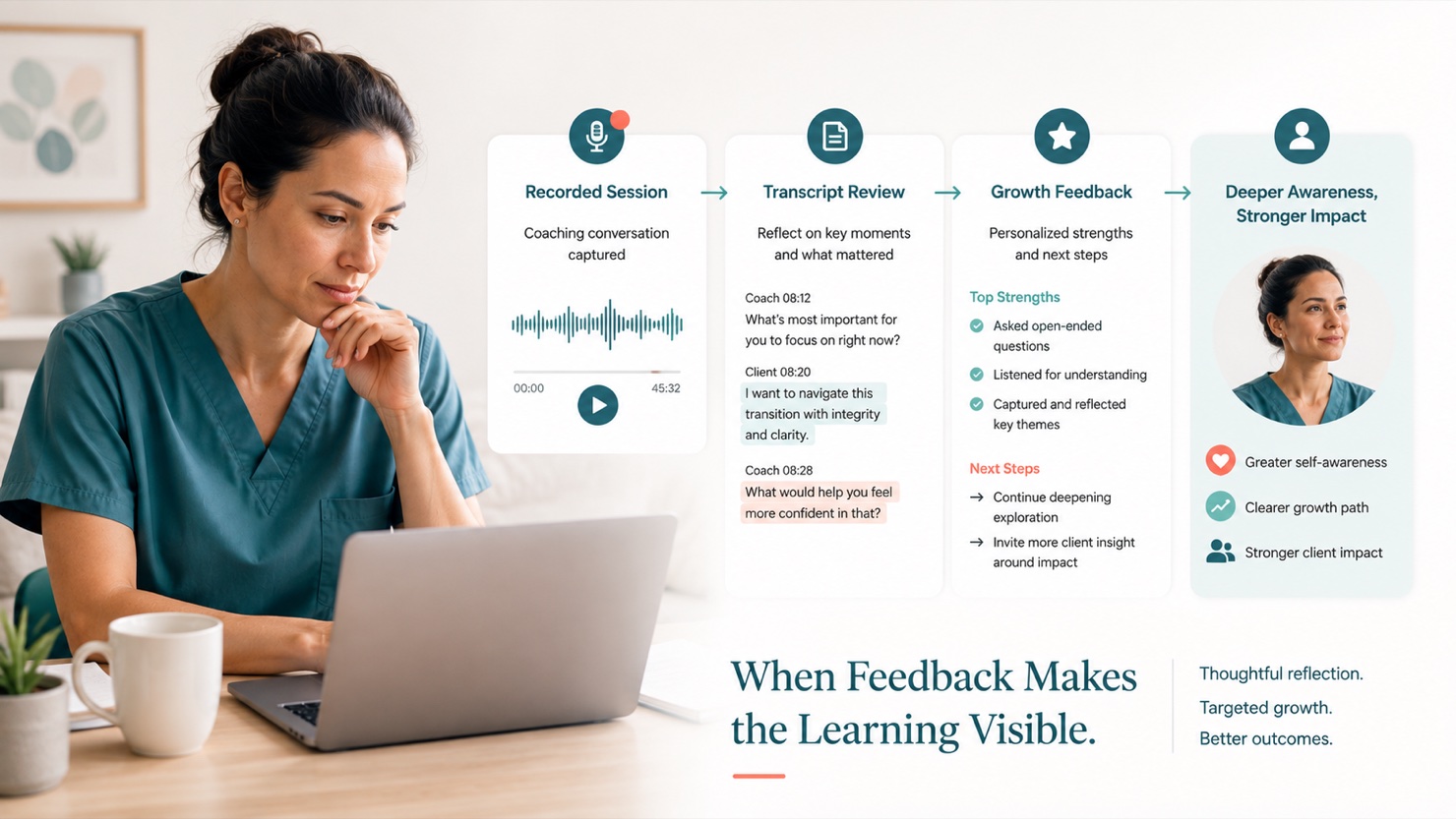
One participant described the session immediately after receiving feedback as the session when she was most inside her own head. She was trying to remember everything she wanted to change.
A couple of sessions later, she noticed a release.
She stopped trying to monitor every move while she was coaching and began reflecting more effectively after the session instead.
From coaching inside your own head to becoming present with the person in front of you.
That shift is not the same as claiming mastery.
It is grounded professional self-trust.
Participants leave with a clearer understanding of:
- what they are already doing well
- what their real habits sound like in conversation
- what they need to practise next
- how to catch and redirect themselves
- how to keep learning after Into Practice ends
Ready to move from peer practice into real implementation? Bring everything you have learned into a supported coaching relationship with a real client.
Take My Coach Approach Into Practice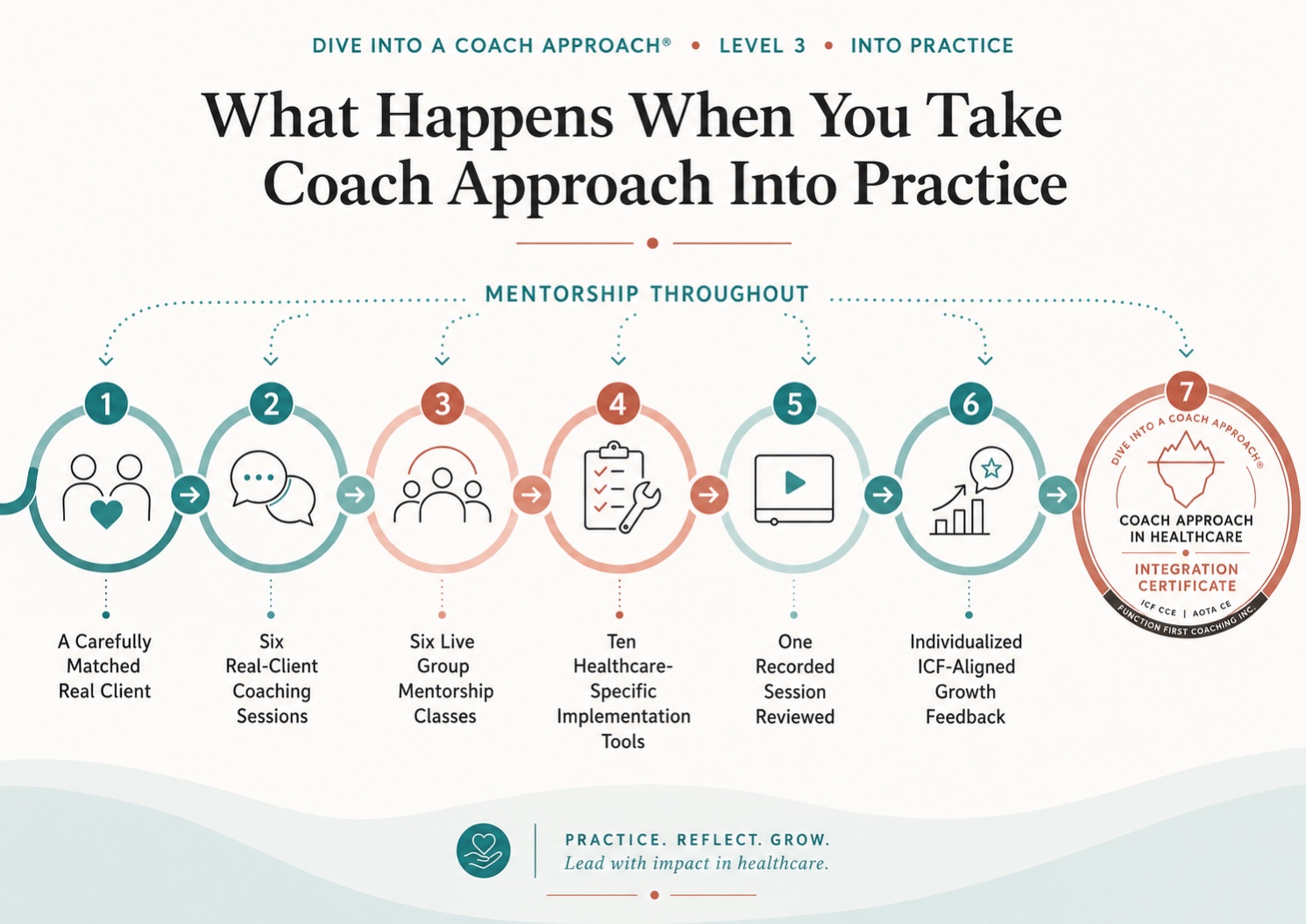
Across Into Practice, you will coach one carefully matched client through six sessions, participate in six live group mentorship classes, apply ten healthcare-specific implementation tools, submit one recorded coaching conversation, and receive individualized Growth Feedback aligned with the ICF Core Competencies.
The Map I Had to Build the Long Way
When I first began integrating a Coach Approach into my own clinical work, I did not have a complete methodology.
I had questions.
A lot of them.
How should I introduce this approach to an existing client?
What needed to change when I introduced it to someone new?
What should the agreement include?
How could I weave coaching into a longer intervention rather than using it in one isolated session?
What should happen midway through the process?
How would I close the relationship and evaluate what had changed?
I built tools one by one to solve the immediate problems in front of me.
I tried them.
I changed them.
I adapted them for clients with different symptoms, goals, communication styles, and levels of readiness.
Sometimes they worked.
Sometimes they did not fit cleanly.
And sometimes I entered a session still wondering whether I was doing any of it correctly.
A few years later, I stepped back and realized something.
I had developed a methodology from the beginning of a clinical relationship to the end, but I had never formally named or standardized it.
Creating Into Practice gave me the structure to do just that.
I needed to turn what had taken me years of trial, reflection, research, adaptation, and clinical experience into a structure that another healthcare professional could follow without having to stumble through the same process alone.
That became the implementation pathway participants now follow throughout the course.
Participants receive tools to support the full client journey, including how to:
- introduce the Coach Approach
- establish agreements and expectations
- clarify what matters to the client
- guide individual coaching sessions
- integrate coaching with existing professional services
- reflect between sessions
- evaluate progress and outcomes
- complete the coaching relationship well
The tools offer a starting point.
They are not intended to remove professional judgment.
When the Methodology Becomes Yours
Standardized enough to support you. Flexible enough to fit your practice.
Participants do not complete Into Practice by reproducing my forms and scripts exactly as written.
They use them.
They test them.
They reflect on what worked.
Then they adapt them.
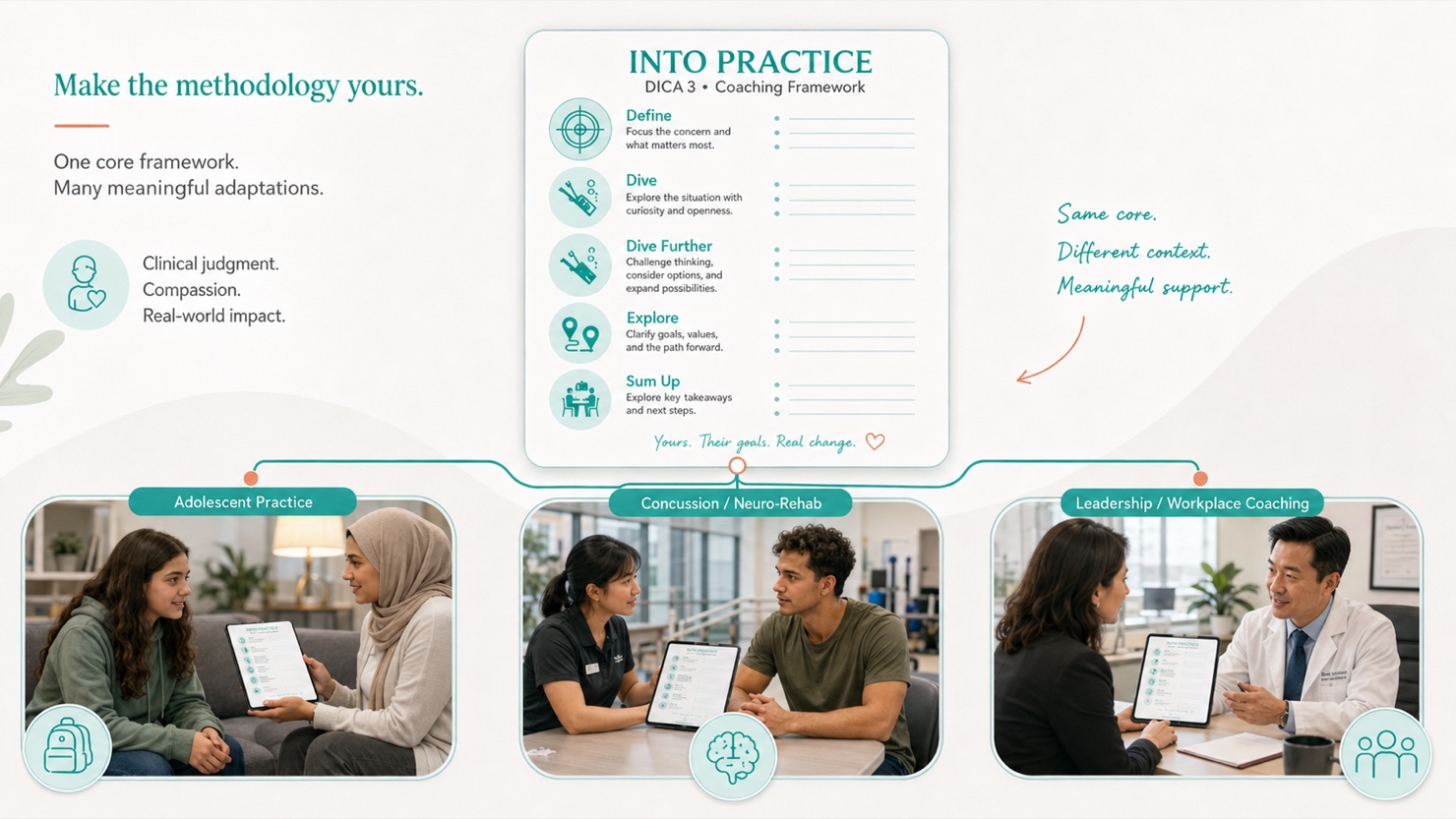
A physiotherapist coaching teenagers may need to change the wording and structure of an intake process originally created for adults.
A practitioner working with someone who has a learning disability may need to simplify questions, offer more processing time, or change the format of a worksheet.
Someone working in concussion, persistent pain, cancer rehabilitation, leadership, or return to work may need to add questions that reflect the realities of that population.
You know your field.
You know your professional scope.
You understand the people you serve in ways that a general coaching program cannot.
Into Practice gives you the implementation structure so that you do not need to invent everything from scratch. Your professional expertise helps you determine how to make that structure fit.
You are not learning to practise like me. You are learning to integrate a Coach Approach into the professional you already are.
That is an important difference.
The Coach Approach is not intended to replace the healthcare profession, helping role, or leadership expertise you have spent years developing.
It becomes an additional way of working.
By the later sessions, the tools often begin to feel less like unfamiliar templates and more like resources participants can select, adapt, and use intentionally.
The framework remains available in the background, but it no longer needs to appear in exactly the same way in every conversation.
One graduate described learning to stop searching for every part of the framework in every session.
She relaxed.
She made it hers.
That is integration.
Then Their Clients Told Us What They Experienced
Participants may begin Into Practice wondering whether they are ready.
The clearest evidence often comes from the people on the other side of the conversation.
Clients have described feeling listened to, safe, valued, unrushed, and supported to identify their own way forward.
They have also noticed when practitioners adapted the process to fit how they think, communicate, and make decisions.

“She listened, was patient with me, and followed my lead rather than pushing her agenda.”
KimGet Coached client
“She listened and understood, and let me come up with my OWN actions.”
SamanthaGet Coached client
“She paused and waited while I thought about my answers. She repeated back what she heard and made sure she had interpreted it correctly.”
ChristiGet Coached clientThese comments matter because the practitioners were still learning.
They were noticing their habits.
They were adapting their tools.
They were catching themselves when they slipped into the expert role.
They were receiving feedback and trying again.
They were not flawless.
Yet the clients experienced presence, partnership, ownership, and meaningful movement.
Into Practice is not built around the promise that you will complete six sessions with nothing left to learn.
It is built around something more honest:
You can create real value while continuing to develop your craft.
Curious about the experience from the client’s perspective?
Meet the Get Coached program ›
What Healthcare Professionals Are Saying
Real graduates of Dive Into a Coach Approach®, in their own words.
-
“Through the Dive Into a Coach Approach™ program, I gained confidence in client interactions, improving outcomes, and strengthened peer relationships. It enabled me to seize growth opportunities within the organization, applying coaching principles in clinical and leadership roles.”
-
“The Dive Into a Coach Approach™ certification provided incredible insights and opportunities to support clients. It made me a better, more relaxed therapist, excited for my clients’ growth due to their inner strengths.”
-
“The Dive Into a Coach Approach™ certification is a transformative journey, advancing both personal and professional growth. I am forever grateful to my organization for supporting this accredited program.”
-
“Completing the full Dive Into a Coach Approach™ certification pushed me out of my comfort zone. It was challenging but immensely rewarding, revealing the true value of coaching and its exciting, greater impact.”
-
“The Dive Into a Coach Approach™ certification greatly enhanced my skills and practice. Immediate application, supportive feedback, and practice with a coaching partner were invaluable. As a seasoned OT, this refreshing addition has reduced burnout and improved client outcomes.”
-
“The Dive Into a Coach Approach™ certification transforms both practitioners and their clients. You gain self-insights that not only enhance your professional skills but also positively impact the lives of everyone you work with.”
-
“Working with your own client while receiving support from fellow coaches-in-training and Hélène is invaluable. Regular check-ins provided new insights to apply in my coaching sessions, and the supportive environment made the journey enriching.”
-
“After completing the Dive Into a Coach Approach™ certification program, I’ve observed a noticeable shift in our team culture—it’s empowering me as a leader and instilling confidence in our client interactions. This training has significantly enhanced client satisfaction while boosting team morale.”
A Culmination and a Threshold
Into Practice completes the first three levels of the Dive Into a Coach Approach® journey.
When you finish, you earn your:
Coach Approach in Healthcare Integration Certificate and the accompanying digital badge.
The word Integration was chosen intentionally.
It represents more than completing another course.
You have:
- built the knowledge foundation
- practised with peers
- developed greater self-awareness and Relationship Intelligence
- coached a real client across six sessions
- applied and adapted a healthcare-specific methodology
- received client feedback
- reviewed your coaching through individualized Growth Feedback
- identified both your strengths and your next areas for development
You have taken the Coach Approach into a real professional relationship.
You have begun making it your own.
Integration Does Not Mean There Is Nothing Left to Learn
Into Practice is both a culmination and a threshold.
Some graduates will take what they have built directly into their clinical practice, leadership work, education, or business.
They may develop new services, use the methodology within their current role, or integrate the tools into the client relationships they already have.
Others will realize that they want to continue toward an ICF coaching credential.
Into Practice helps keep that door open.
DICA 4: ICF Readiness & Mentorship is the optional next chapter for graduates who want personalized assessment, further feedback, and support as they prepare for the ICF ACC credentialing pathway.
DICA 4 currently supports DICA graduates with an ICF-aligned performance evaluation, written feedback, mentorship, credential-log review, and exam-preparation resources.
Interested in continuing toward ICF credentialing? DICA 4 is the optional next chapter after completing Into Practice.
Explore DICA 4: ICF Readiness & MentorshipReady to Take It Into Practice?
There comes a point when more information is not the next thing you need.
You need a real person.
A real goal.
A methodology you can apply from beginning to end.
A place to bring your questions when the conversation does not unfold as expected.
Feedback that helps you hear what you cannot yet hear alone.
And enough support to stretch beyond peer practice without being left to figure it all out by yourself.
Into Practice gives you real responsibility within a carefully supported learning experience.
You will not leave believing that you have nothing left to learn.
You will leave with something more useful:
A methodology you have used.
Tools you have adapted.
Feedback you can act on.
Evidence of the impact you can create.
And greater trust in the professional you bring into every conversation.
2027 Live Cohort Schedule
All classes are live online from 12:00–1:00 p.m. Pacific Time (PT). Classes marked with an asterisk (*) are mandatory to attend live or view the recording.
- Class 1 January 13, 2027 *
- Class 2 February 3, 2027
- Class 3 February 24, 2027 *
- Class 4 March 24, 2027
- Class 5 April 14, 2027
- Class 6 May 5, 2027 *
Your six 1:1 coaching sessions with your Get Coached client are scheduled separately at a time that works best for you and your client. Function First Coaching Inc. will consider your availability when selecting your Get Coached client.
It is time to take the Coach Approach into practice and make it yours.
Bring the Coach Approach into a real, supported client relationship.
Take My Coach Approach Into Practice